
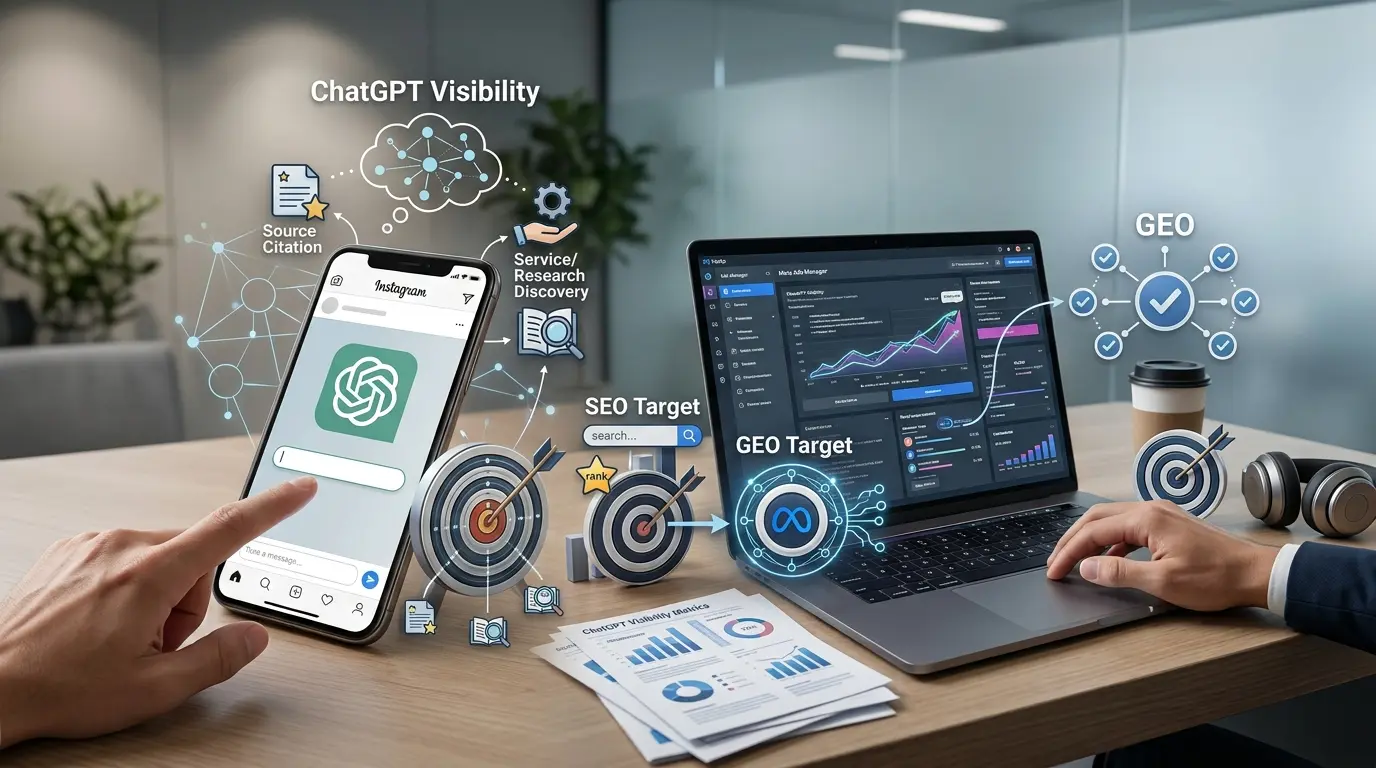
Does GEO make sense for a small brand?
Yes, it can make sense under the right conditions. If your customers research before buying, compare options and seek expertise, being a clear source in AI answers is valuable. A business does not have to be large to do this, but being small is not in itself a reason to invest. An accessible website, clear product or service information and a measurable contact journey should come first.
For a brand with a limited budget, the starting point is to make existing SEO and content work useful for AI-assisted research too. Instead of adding a new expense simply called a ‘GEO package’, clarify which customer question you will answer, on which page and for which business goal.
What is GEO?
GEO is a term for work that helps generative AI systems understand your brand and content accurately and, where appropriate, consider it as a source. It is not a registration service that puts a brand into every answer, or guaranteed advertising space.
Google explains that existing SEO principles apply to AI Overviews and AI Mode, with no additional special optimisation requirement. It would therefore be misleading to present GEO as a technical product entirely independent of SEO. See Google’s official explanation for details.
How should you decide?
The real question should be ‘What does my customer research before deciding?’, rather than ‘How many employees do I have?’ Comparison and use-case content may help a small manufacturer selling a technical product. For a business providing a quick service in one neighbourhood, accurate local information and easy contact may take priority.
Real experience in a niche gives you strong material for content. If you have recurring customer questions, example projects and expertise you can explain clearly, you can turn these into lasting web pages. This does not guarantee visibility equal to large brands; it gives you a more focused area of work.
When should you start?
A small initial scope may be worth considering if the purchase decision involves research and comparison, your service requires specific expertise and you can improve your website regularly. There should be a clear relationship between the question the customer asks and the solution your business provides.
For example, a boutique hotel explaining room types, location and travel conditions; a manufacturer comparing product models using concrete features; or a consultancy explaining its scope and real project experience can all help users and the structure of digital information. These are content-planning scenarios, not evidence of performance.
What should you fix first?
If your website will not open, your pages cannot be crawled, your service is unclear or mobile users cannot contact you, fix these issues first. Simply adding blog posts may be the wrong priority when phone numbers are incorrect, addresses outdated, pricing scope unclear and forms broken.
If you need urgent enquiries within the next few weeks, do not plan organic visibility as your only short-term solution. Existing customer relationships, local visibility, the sales process and suitable advertising channels can be assessed together. Choose channels according to the sector and the business’s actual circumstances.
GEO decision table
| Current situation | Suggested first step |
|---|---|
| Website or contact journey has problems | Resolve technical access and conversion gaps. |
| Customers do extensive research and comparison | Start small with a service page and decision-making questions. |
| Demand is mainly local and urgent | Prioritise the actual service area, business information and contact. |
| SEO and original expert content already exist | Improve clarity of information, links and measurement. |
Priorities on a limited budget
Complete your most important product or service page first. Explain whom you serve, the scope, area, process and contact step. Then identify recurring decision-making questions from customer conversations. Make a small number of pages truly useful rather than spreading the budget across many superficial texts.
The business owner or expert team should provide original knowledge. The agency’s contribution should connect this knowledge to search intent, technical structure, content organisation and measurement. If monthly available time, the person responsible for content approval and the scope you can keep current are unclear, establish a sustainable workflow first.
An example starting scope
You might begin with one main service page, guides answering three real customer questions and an up-to-date business or expert profile. These numbers are not a mandatory GEO standard; they are an example of a manageable scope with limited resources. Every article should help the customer decide and link naturally to the relevant service page.
For a furniture workshop, starting questions might cover ‘the made-to-measure order process’, ‘usage conditions affecting material choice’ and ‘delivery coverage’. Explaining its own production experience may be a more practical content plan than publishing generic decorating articles every day.
Technical checks
Check page accessibility, indexing status, mobile usability and whether important information appears as text. Headings, page addresses and internal links should make the service architecture understandable. Any structured data should match visible content; a special ‘GEO schema’ does not guarantee results.
For ChatGPT search, OpenAI highlights access for OAI-SearchBot and avoiding blocks on the published search crawler IP ranges. OAI-SearchBot for search and GPTBot for training have separate controls. Access decisions should reflect the site’s preferences; crawler access must not be presented as a guarantee of citation. OpenAI’s crawler documentation explains the distinction.
GEO for local businesses
A small business serving Kaş does not need to create content for every city. Its real service area, up-to-date business details, first-hand experience and clear contact options provide a more useful starting point. Regional pages should describe only services actually provided.
A boutique hotel accurately explaining parking, access to the centre, room differences and booking conditions, or a local service clarifying its coverage and scope, answers customers’ decision-making questions. Incorporate AI visibility into your SEO and GEO work plan alongside this information foundation.
How should the budget be set?
There is no sound single minimum budget applicable to every small brand. Cost varies with existing website problems, the number of products or services, the need for expert content, languages and measurement scope. Define the deliverables first, then compare prices.
The proposal should specify which pages will be prepared, the scope of technical checks, who will supply information and approvals, update frequency and the indicators to be reported. Ask for concrete deliverables and an evaluation method rather than a vague promise to ‘introduce you to AI’.
How do you measure success?
Record the starting position: which pages receive visits, which questions generate enquiries and through which channels people get in touch. In the following period, review relevant queries, qualified referrals, brand searches and actual enquiries together. Account for the limits of each data source and changing sales conditions.
Brand mentions or citations for specific questions can form part of regular monitoring. One screenshot, however, does not represent every user. Record conditions such as query, date, language and location. Compare visibility changes with enquiry and sales records before attributing a rise in sales directly to them.
A 90-day starting plan
During the first 30 days, check technical access, business information and the most important service page. Gather customer questions from sales conversations and record baseline data. During the next 30 days, answer priority questions with original knowledge and link guides to the relevant service and expert profile.
On days 61–90, assess content gaps, incoming questions and the contact journey. Develop topics that prove useful; do not focus solely on increasing the number of publications. This is an implementation and initial review plan, not a guarantee of visibility or sales within 90 days.
Our approach
We recommend identifying gaps in your existing digital setup rather than treating GEO as a separate fashionable budget item. Real expertise, clear product and service information, technical access and regular measurement should work within the same plan.
For more detailed implementation, see our guide to brand visibility in ChatGPT; to assess business outcomes, read our article on zero-click marketing . We can clarify the right scope for your brand through SEO and GEO consulting .
Where should your brand start?
Share your website and priority. Let us define the scope together.
Frequently asked questions
Can small brands appear in AI answers?+
Brand size alone is not an eligibility criterion. Providing accessible, relevant and trustworthy information matters; visibility cannot be guaranteed for any brand.
Should I stop SEO to focus on GEO?+
No. Technical access, clear service information and useful content are shared foundations. Plan your existing SEO work around these needs too.
Do I need to publish a blog every day?+
No. There is no mandatory publishing frequency. First prepare original, current answers to questions that affect customers’ decisions.
When will I see results from GEO?+
There is no single timeframe. The website’s condition, competition, content and platform changes influence results. Set a regular review schedule instead.
Official sources
The decision table, initial scope and 90-day plan are Sosyal Zeplin’s working recommendations, not mandatory standards set by platforms.