
The insurance agency does not have to remain an account that only watches other people's content on social media. The agency's knowledge, approach and daily working life can also turn into the content people need when making decisions. There's no need to wait for the perfect studio or viral idea to get started; Regular sharing, understandable information and correct video editing provide a sufficient start.
I don't see social media as just a showcase for product announcements. I consider it a communication area that simply answers people's questions about insurance, shows how the agency works, and establishes a relationship of trust over time. The goal here is not to sell in every video; To deliver the right information to the right person in an understandable manner.
First, move from being a spectator to being a producer
Many business owners spend time on social media during the day; He studies examples in the industry, watches trends, and looks at other people's videos. These may give you an idea. However, if your account constantly consumes and never produces, your target audience will not have the opportunity to get to know your approach.
Finding topics for content in insurance agency is not as difficult as it is often thought. The questions that customers ask repeatedly, the concepts they are confused about when receiving a quote, the points they wonder about during the policy renewal period, and the daily operation of the agency are powerful sources for a start. Not every post has to be a big campaign.
Moreover, you don't have to talk only about the product. You can also show how you keep track of your team, your work, research a question, or plan a day. Personal sharing does not mean completely breaking away from the professional topic; It is a way to tell people who is behind the brand. Customer information, policies and private correspondence should never turn into content material.
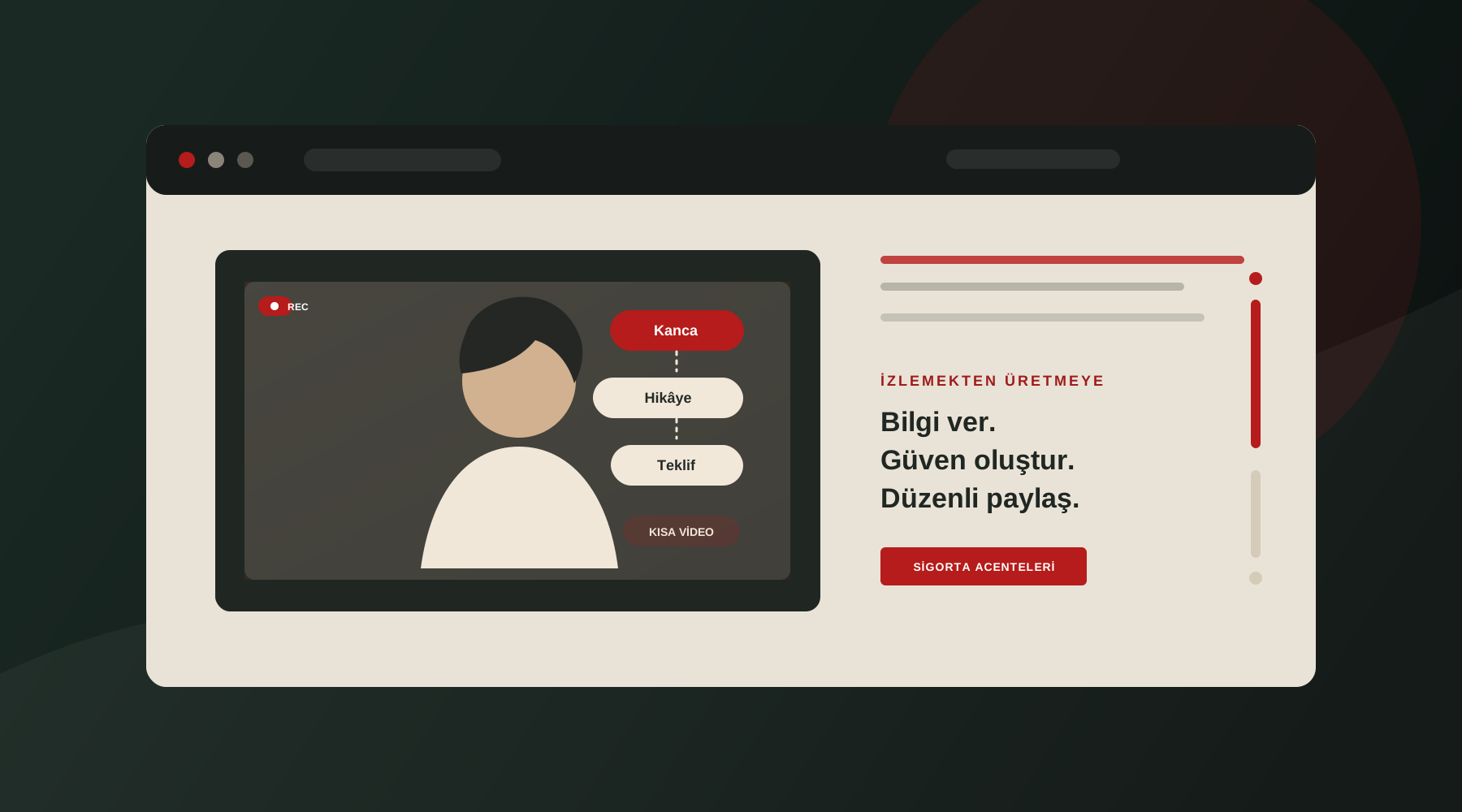
Hook–Story–Proposal formula for short video
To easily plan a short video, you can use a three-part structure: Hook, Story, and Proposal. This is not a guarantee formula; It is a practical framework that helps understand the message faster.
- Hook: State the audience's question or risk directly in the first sentence. Instead of starting with a long introduction, “Hi, I'm…”, get to the point.
- Story: Explain a concept, process, or common confusion with a brief example. Let the viewer get concrete information from the video.
- Offer: Suggest a single next step. Like registering, asking a general question in a comment, looking at the profile link or contacting the agent for a personal evaluation.
An example structure might be:
Hook: “When comparing car insurance quotes, do you only look at price?”
Story: "In addition to the price, coverage limits, exemptions and assistance conditions may also vary from offer to offer. Therefore, it is necessary to evaluate the two offers under the same headings."
Offer: “Record the titles you check when comparing; consult your agent for clear information about your own policy.”
Another issue may be what to do after damage to home insurance:
Hook: “What information should be noted first when damage occurs at home?”
Story: "Documenting the date of the damage, its apparent condition and photographs, if any, may make it easier for you to follow the process. The notification method and required documents may vary depending on the policy and the insurance company's guidance."
Offer: “In case of damage, check the communication and notification steps in your own policy; if you are not sure, get support from your agency.”
These examples are for general information. Each product's coverage, exclusions and transaction steps may be different. Before publishing content, compare the information you use with current product documentation and approved statements from the insurance company.
First videos don't have to be perfect
In the first attempts, the lighting, sound, comfort in front of the camera or expression may not be what you want. This is normal. What often puts off content is not a lack of equipment, but the desire to perfect every detail before publishing.
A phone, window light and a clear voice are enough to get started. Stabilize the frame, answer one question in one video, and cut out unnecessary intros. Before sharing the first footage, watch it and correct just one thing: for example, the audio, the first sentence, or the length of the video. This way, each new attempt becomes a small learning opportunity.
If unreleased videos are piling up in your phone gallery, select one and watch it again. If there is no misinformation, personal data or privacy risk and the narrative is understandable, publish it. To see what the market reacts to, it is necessary to produce content first; It is not possible to know for sure which video will be watched in advance.
Aim for a sustainable order, not a share
Sharing videos every day isn't realistic or necessary for everyone. The important thing is to establish a rhythm that the agency can maintain without interrupting its workload and to try different subject formats. For example, you can start with two short videos and one Q&A post per week. This is not a prescription; It is an initial plan that will be adjusted according to the capacity of the team.
- Take note of a week's worth of frequently asked questions.
- Create a single short video topic from each question.
- Record videos in the same shooting session, with different introductory phrases.
- Use one main message and one call for each video.
- Post-broadcast is not just about viewing; Also see watch time, saves, qualified messages and real conversations.
Just because a video has few views may not mean that the topic is worthless. Maybe the introductory sentence is not clear enough, maybe the distribution time is different, maybe the content is useful for a narrower audience. Instead of making a decision based on a single post, try similar topics with different expressions and evaluate the results together.
The call for proposals can also be made without pressure.
It's helpful to tell the viewer what to do at the end of the video; But not every content has to end with a "buy now" call. Depending on the purpose of the content, you can choose a more natural next step:
- Informative content: “Save this checklist to use during the policy renewal period.”
- In the question and answer content: "Share your general questions in the comments; do not write your personal information in the public area."
- In the service introduction: "You can contact our agency to evaluate the options that suit your needs."
An onstage call, such as “DM 20K,” may be designed for a specific educational or commercial goal. This should not be seen as a formula that will suit every agency and provide a certain premium or sales result. It would be better for the agency to choose a single call that suits its own service, target audience and communication style.
Trust in insurance comes before watching the video
In insurance communication, speaking accurately and measuredly is as important as arousing curiosity. Statements such as “it covers every damage”, “you will receive a definite payment” or “we have the cheapest policy” may create false expectations if the basis and scope are not clear. Do not leave product terms, exclusions and company information vague; When making a comparison, clearly explain what is being compared.
Insurance advertising principles published by SEDDK require agencies to comply with a clear and non-misleading advertising approach that includes accurate information. Additionally, carefully consider personal data and required permissions before sharing a customer story, screenshot, policy sample or claim document. Publishing a person's image or information on a social media account may constitute personal data processing activity.
Therefore, include a quick pre-publication check in your content calendar: Is the information accurate and up-to-date? Does it overstate the policy conditions? Does it contain personally identifiable information? Is the call clear and unpressured? These questions help maintain trust without hindering creative expression.
Three video ideas you can start today
- “Look at three titles when comparing offers” — simply explain the coverage, limits and exclusions according to the relevant insurance type.
- “What are the first steps in reporting damage?” — describe the general process, noting that details may vary by policy and company practice.
- “What information should you prepare when consulting with the agency?” — give the audience a general checklist to facilitate the interview.
Draft each idea in the form of Hook–Story–Proposal, shoot your video and publish it. Then improve your narrative by looking at views, recordings and questions. To get results on social media, it is necessary not to look perfect, but to share the correct information regularly and in a humane language.
Frequently asked questions
What can an insurance agent share on social media?
Frequently asked general questions, basic insurance concepts, process explanations, team introduction and the agency's working style can be shared. For policy-specific answers, the relevant conditions should be checked; Personal or sensitive customer information should not be published.
How should an insurance agent start short videos?
Choose one question that customers frequently ask. State the question in the first sentence, give a brief and clear explanation, then suggest a single next step. You can start with a simple frame, on the phone.
Should Hook–Story–Proposal be used in every video?
This structure helps plan short videos; but it is not a mandatory pattern for every format. Adapt it according to the purpose of the content and the need of the audience.
Does social media content guarantee sales?
No. Regular content can make the agency's knowledge and approach visible; However, reach, demand and sales results depend on many factors such as target audience, content, offer, distribution and tracking process.

Akın Tığlı
Founder of Sosyal Zeplin Creative. He brings over 15 years of experience to SEO, GEO and digital strategy for healthcare and tourism brands.
Read moreResources and reading notes
- SEDDK: Principles to be followed in Announcements and Advertisements — Principles regarding insurance advertisements containing accurate, clear and non-misleading information.
- SEDDK: Insurance legislation and regulations — Official legislation list for current regulations.
- KVKK: Summary of the decision regarding sharing photos on social media accounts — Example of the data protection aspect of publishing images of people on social media.
This article offers general content and communication suggestions; It is not a substitute for insurance, regulatory or personal policy advice. Confirm product and coverage descriptions with current policy documents and the relevant insurance company.
Where should your brand start?
Share your website and priority. Let us define the scope together.